

Two coils of steel welded together break apart at the weld, mid-process. The line has to be shut down while the steel is removed from it and the furnace has to be cooled before restarting the process. To restart the process, operators spend hours restoring the furnace temperature while the production line sits idle.
That single failed weld, lasting less than 30 seconds to make, can cost a facility an entire day of output, or scrapping an entire $40,000 coil of steel. This is the reality of mash seam welding in steel processing. And it is a problem that thermal imaging-based weld monitoring was built to solve.
Video of A typical Coil Joining Mash Welding Process (courtesy of Taylor Winfield).
What Is Mash Seam Welding?
Mash welding is a type of welding used to join the trailing and leading ends of two coils of thin steel (~1-2 millimeters), enabling continuous feeding of material into a processing line.
It is a type of resistance welding that uses a pair of large, continuously rotating copper alloy wheels to compress the overlapping section of two coils while applying electric current. The electric current generates enough heat and force to forge the material into a welded seam (see fig. 1). [i]
The entire process typically lasts less than 30 seconds because the welded coil is then immediately fed into the production line, whether for coating, annealing, or another production process. The mash weld only needs to hold long enough for the strip to complete its run through the mill. Once completed, the steel strip is converted back into coils, with the welded seams that exist between coils cut out and discarded.
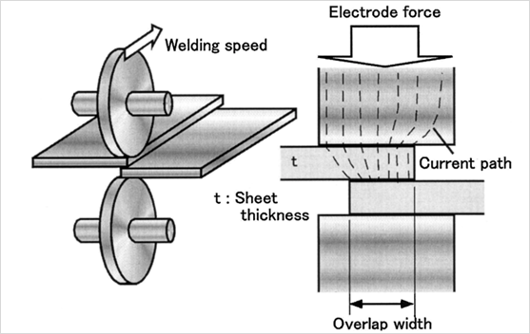 Figure 1: Schematic Illustration of Mash Seam Welding (Source: Nippon Steel Technical Report, Welding Techniques for Tailored Blanks[ii])
|

|
Why Mash Seam Weld Failures Are So Costly
The math of a mash weld failure is unforgiving. Because the strip feeds into a continuous process, a break in the weld does not just mean a bad joint; it means a full-line stoppage. In case of a major failure, the furnace may need to be cooled down, then restarted, and then brought back up to temperature before it can start feeding it, causing hours, or even days, of downtime.
The operator typically has only a few minutes in the strip buffer to assess weld quality before feeding the material back into the mill. There is no practical way to stop the line mid-process without risking destruction of the coil currently being processed. Under these conditions, the quality of a decision made in seconds about the quality of the mash weld can determine hours of downstream consequences.
The Limits of Existing Approaches
Pyrometers are most commonly used by manufacturers to check the temperature of a mash weld during the welding process to make sure it doesn’t have any cold spots that could indicate weaknesses in the weld. But the use of pyrometers is often rejected because of the single-point measurement resolution these tools provide. A pyrometer cannot reliably distinguish between a cold spot at one point along the weld and a cold spot that runs continuously across the bead.
What is needed instead is a thermal camera that can observe the entire weld bead, capture its thermal profile across its full width, track temperature over time, and be fast enough to give timely feedback to the operator.
How Thermal Camera Monitoring Works for Mash Seam Welding: A Case Study
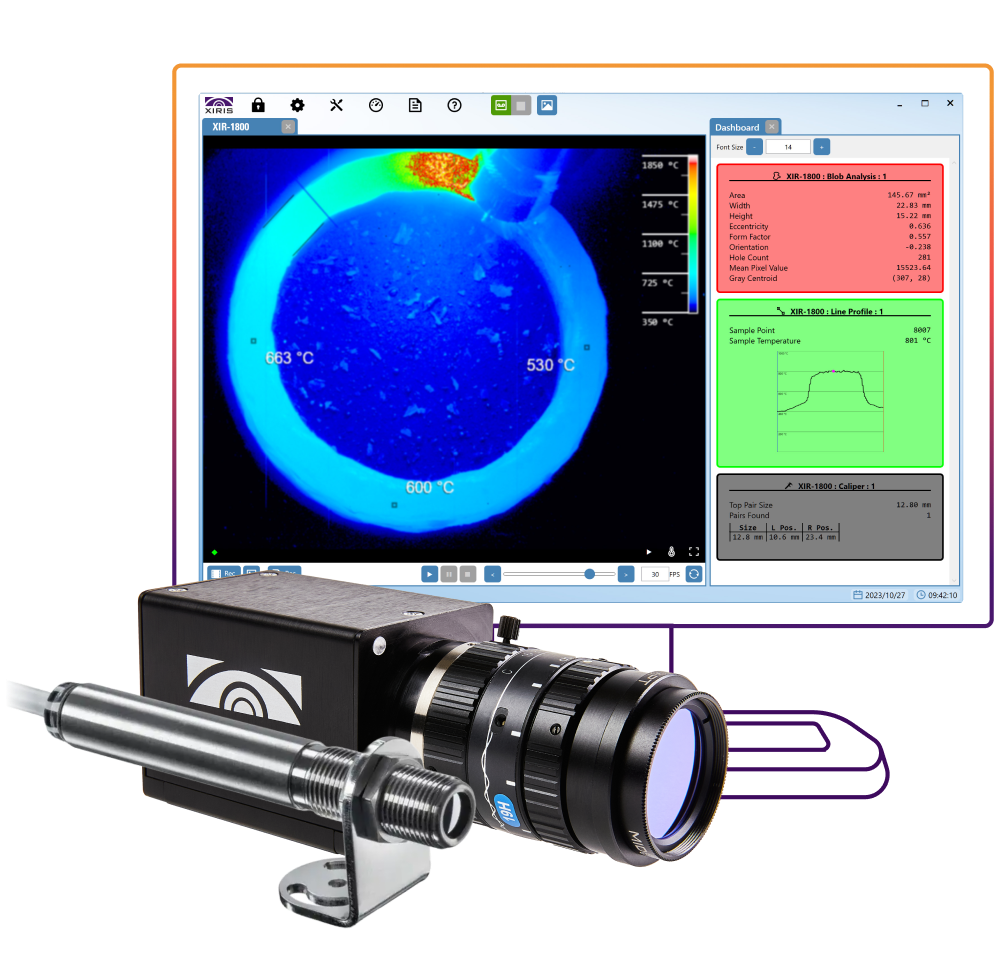
A steel manufacturer recently implemented a monitoring system for its mash seam welder consisting of an XIR-1800 camera, a Xiris CellView camera, and an industrial fanless PC running WeldStudio Pro. The processing software module used OPC-UA communication from the line’s PLC to synchronize process data and weld identification with the monitoring system.
The system enables real-time visibility and traceability throughout each weld cycle. Before the start of each weld, the PLC communicates a Weld ID number and a target weld temperature to the software via OPC-UA.
During the weld, the software continuously measures weld bead temperature and bead width, comparing both against user-configured tolerance limits. Configurable tolerances limits define the acceptable operating range for each monitored metric. If all parameters remain within tolerance for the full duration of the weld, the completed weld record is displayed on the computer screen in green (see Figure 2). If any parameter exceeds its tolerance limits at any point, the record turns red, providing an immediate indication of potential quality deviation.
On weld completion, a full weld record is generated, including stored video, measured data, and screen captures (indexed by Weld ID). During the weld, the software also communicates all reading values to the PLC in real time, allowing the customer to use the data within the welder.
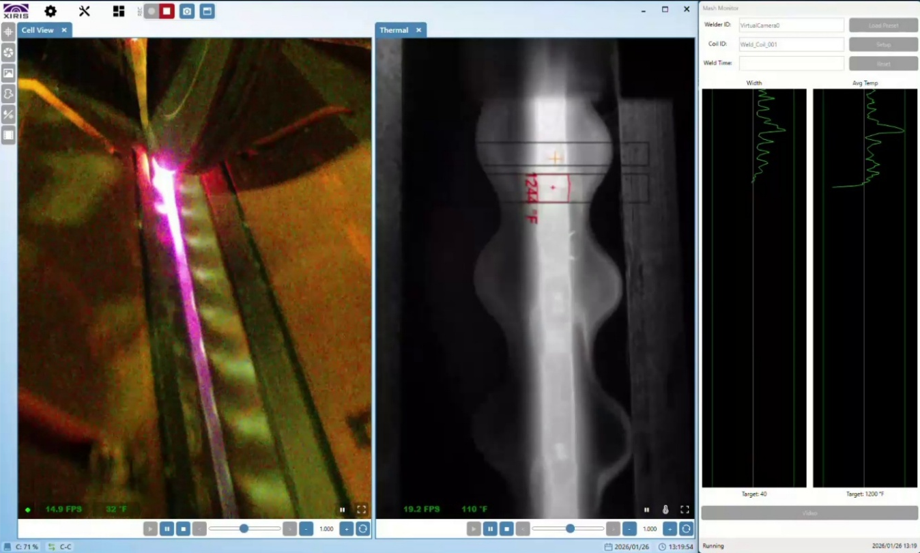
A screen recording (Figure 2) from the installation described above illustrates how the system operates in real time, showing how the software, cameras, and PLC work together to monitor weld quality:
|
Figure 2: Real-time mash seam welding monitoring interface displaying visual camera feed, XIR-1800 thermal imaging, and weld bead temperature/width trends |
The display is divided into three panels:
- Left panel — Colour video feed from the visual camera, showing the mash weld process from above.
- Centre panel — XIR-1800 Thermal camera output displaying the thermal profile of the weld bead, with overlaid measurement tools tracking local heat points across the bead.
- Right panel — Graphical display of weld bead temperature and bead width plotted over time, with green/red pass/fail indication against the user-specified limits.
The graph retains approximately the last 10 seconds of measurement history, giving the operator a rolling view of weld behaviour rather than a single-point snapshot of the process.
Defect Detection in Practice
If there is contamination in the weld bead, the thermal camera image can reveal hotter and colder spots on the solidifying weld bead. These temperature variations reflect resistance changes in the joint caused by steel composition shifts or wheel surface irregularities, creating momentary cold spots.
Not every anomaly is a failure. An isolated spot would be accepted as it may not have a material impact on the strength and integrity of the weld. But if the cold spot were continuous, that could represent a major welding defect. The green and red graphic system was specifically designed by Xiris to address exactly this challenge, establishing a “Go, No-Go” system for weld acceptance.
Operator Decision Flow
At the end of each weld cycle, the operator checks the display. A green result confirms the weld is within specification. A red result, especially when the temperature curve remains at the lower end of the acceptable range, gives the operator the information needed to decide whether to cut out and re-weld.
Because the steel strip passes through a continuous process that cannot be stopped without destroying the coil, the operator has only a few minutes to complete the weld and assess its quality. The operator must quickly determine whether the mash weld holding the strip ends together can safely pass through the processing mill.
That decision, previously made on experience and instinct, is now supported by objective, quantified data from every weld cycle.
Summary
Mash seam welding is a short process with long consequences. A weld that fails in service does not just break a joint — it can shut down a production line for hours and generate scrap material worth tens of thousands of dollars. The window to catch a bad weld and act on it is narrow.
Xiris’s XIR-1800 Thermal Camera monitoring system with automated pass/fail evaluation gives operators the data they need, in the time they have, to make the right call.
By bringing objective measurements to the temperature of the weld bead at specific cooling points and the weld bead width, operators can make faster, more accurate decisions about weld quality before potentially defective welds enter the next phase of processing. The result is less scrap and rework for the steel processing facility.

|
Sources:
Follow Xiris on social media for regular updates and welding videos!