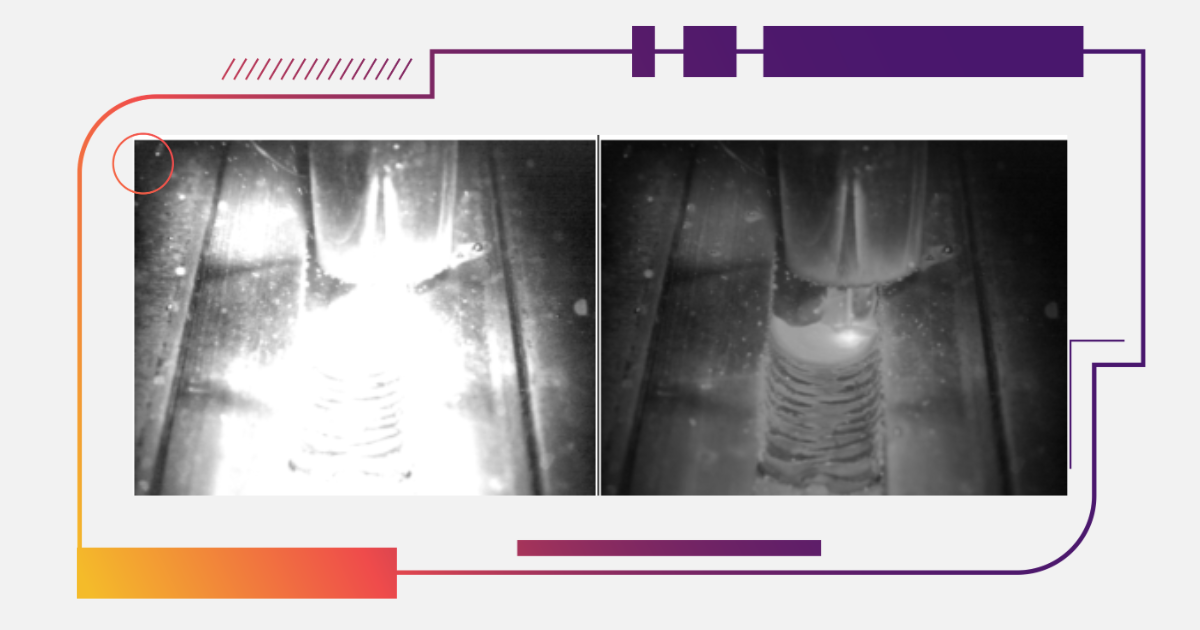


TIG Welding operators know that tungsten electrode wear is a hidden threat, potentially causing weld defects and expensive rework.
What if you could detect electrode damage early, in real time?
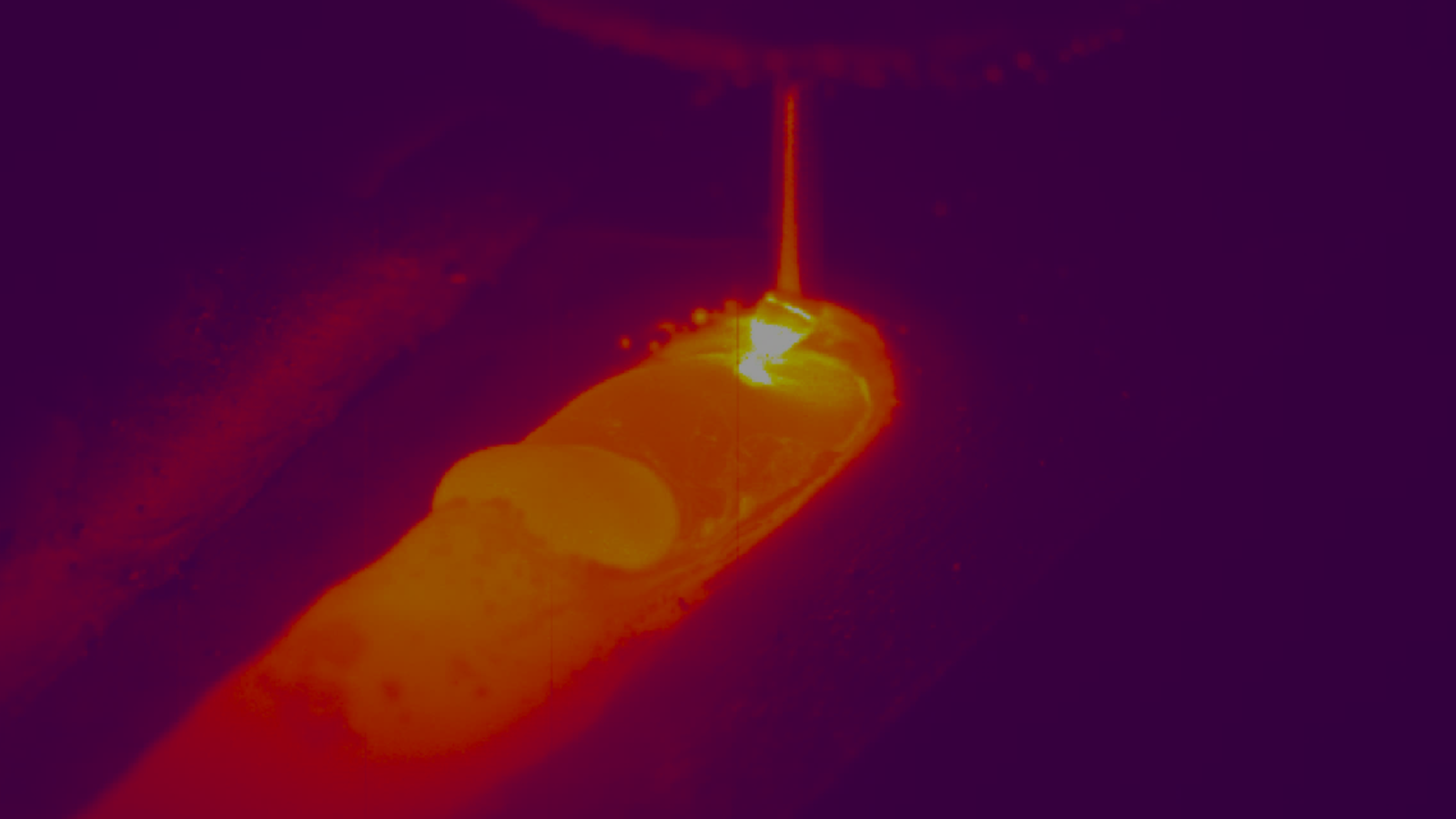
Wolfram Industrie experimented on their tungsten electrodes using the Xiris XIR-1800 thermal camera with exactly that goal in mind.
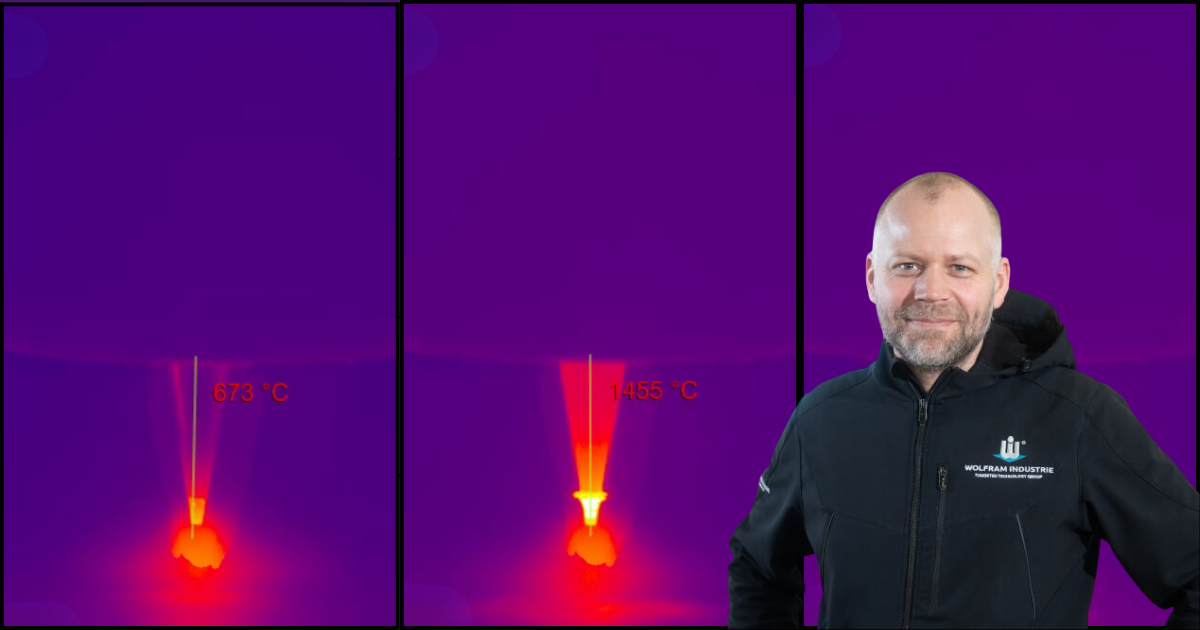
Wolfram Industrie is Germany’s leading tungsten electrode manufacturer, backed by four generations of expertise. Matthias Schaffitz (Application Engineer) and Mateo Tournoud (Research Engineer) bring deep industry knowledge to this experiment. They tested how oxygen contamination degrades tungsten electrodes during welding. They conducted this test on a real-world welding setup to monitor electrode temperature and wear by adding oxygen in tiny increments to an argon gas mix.
The key? The Xiris XIR-1800 Thermal Camera captured precise heat signatures and shape changes on the electrode tip, revealing early oxidation and heat buildup before visible damage occurred. The outcomes are significant for industries such as tube and pipe manufacturers, where weld quality is critical, and defects are costly.
 |
A deep dive into the Q/A with Wolfram’s engineers:
What was the goal of testing tungsten electrodes with a thermal camera?
Schaffitz: We aimed to investigate how tungsten electrodes respond to slight contamination by adding small amounts of oxygen, hydrogen, or nitrogen to the shielding gas. This helped simulate real-world welding conditions and measure their effect on electrode temperature and wear. We used an XIR-1800 thermal weld camera to track the temperature along the weld seam. It revealed early signs of oxidation that traditional inspection methods often miss. Ultimately, we wanted to evaluate how different electrode types and grinding shapes resist oxidation and identify early indicators of wear.
Why is oxidation such a critical failure mode?
Schaffitz: Oxidation degrades tungsten by forming brittle oxides on its surface, which can break off during welding. This not only reduces electrode life but also risks contaminating the weld pool, especially in high-purity applications. Because it's hard to detect early on with the naked eye, oxidation often goes unnoticed until it affects arc stability or weld quality. In theory, the temperature of a tungsten electrode should increase with oxidation, making it visibly distinguishable in real time with thermal imaging. Discovering this proved that tungsten wear is both monitorable and predictable.
Why choose the Xiris XIR-1800 thermal camera?
Tournoud: As a lab with access to various diagnostic tools to test welding processes, such as optical cameras, spectrometers, and thermocouples, the XIR-1800 thermal camera stood out for this experiment. Unlike thermocouples, which can fail at high temperatures, the XIR-1800 offered a non-contact, robust solution with a broad temperature range. This made it ideal for capturing early signs of tungsten electrode degradation. The XIR-1800 allowed us to visualize oxidation-related wear on the electrodes, something we hadn’t observed as effectively using other methods.
How was the experiment set up?
Schaffitz: The XIR-1800 thermal camera was mounted on the leading side of an automatic seam welder, about 8 inches (200 mm) from the weld zone and angled at roughly 15 degrees. This provided a clear thermal view of the electrode tip without interfering with the welding process. A 2% Lanthanated tungsten electrode commonly used in industrial TIG welding was selected for its consistency and reliability in controlled testing.
Were the test results consistent and reliable?
Tournoud: Yes, our results were consistent and repeatable. We ran multiple tests, gradually increasing oxygen levels to identify the degradation threshold. Using a 2% Lanthanated electrode as a standard, we observed predictable damage patterns that corresponded directly to thermal signatures.
The most valuable outcome of this experiment was not a new electrode formulation, but the ability to detect degradation before it impacts weld quality. In production, this means operators can monitor the electrode's condition in real-time and act before weld defects occur.
How can this technology be used in real production?
Schaffitz: Although lab-based, the experiment was conducted under conditions designed to closely replicate real-world TIG welding production environments. This approach ensured the data was not only scientifically valid but also directly applicable to industrial welding processes.
This approach is particularly effective in automated environments with long, continuous welds, such as tube mills, pressure vessels, or automotive lines. The XIR-1800’s thermal data makes it possible to define a repeatable degradation threshold using standard electrodes and use that signal as a preventive trigger.
It’s a flexible method that doesn’t rely on a specific electrode geometry or alloy. As long as the weld setup provides a clear view of the electrode tip, thermal monitoring of the tungsten electrode can become a reliable, scalable quality control tool that minimizes rework and improves production uptime.
To illustrate how increasing oxygen impacts electrode degradation, the experiment was backed by images taken at key points during the test:
.png?width=640&height=512&name=oxygen%20impacts%20electrode%20%20(1).png)
Figure 1: Ignition under pure Argon atmosphere (10 L/min). No oxygen present, stable temperature, clean electrode tip
|
.png?width=640&height=512&name=oxygen%20impacts%20electrode%20%20(2).png)
Figure 2: Oxygen introduced at 0.005 L/min.
A slight temperature rise begins.
|
.png?width=640&height=512&name=oxygen%20impacts%20electrode%20%20(3).png)
Figure 3: Oxygen increased to 0.010 L/min.
Temperature continues to rise, with early signs of oxidation.
|
.png?width=640&height=512&name=oxygen%20impacts%20electrode%20%20(4).png)
Figure 4: Oxygen increased to 0.015 L/min.
Noticeable temperature spike, rim formation starts.
|
.png?width=640&height=512&name=oxygen%20impacts%20electrode%20%20(5).png) Figure 5: Oxygen increased to 0.020 L/min. Figure 5: Oxygen increased to 0.020 L/min.Significant thermal signature, clear electrode degradation.
|
.png?width=640&height=512&name=oxygen%20impacts%20electrode%20%20(6).png) Figure 6: Oxygen increased to 0.025 L/min. Figure 6: Oxygen increased to 0.025 L/min.Peak temperature, pronounced damage evident.
|
Conclusion
Thermal imaging is transforming tungsten electrode monitoring from guesswork to a precision science. By detecting oxidation before it causes damage, welding operators can reduce downtime, extend electrode lifespan, and ensure higher-quality welds.
Xiris Automation Inc. and Wolfram Industrie have put a new tool in your hands, one that could redefine how you maintain welding quality every day. Contact us for more information.
ReferencesKim, J., Park, H., & Choi, S. (2024). Deep-learning-based defect detection in real-time welding monitoring. Journal of Welding and Joining, 42(3), 145–158. https://www.e-jwj.org/journal/view.php?number=2032344 Li, Y., & Zhang, P. (2021). Research and prospect of welding monitoring technology based on machine vision. Proceedings of the 18th International Conference on Informatics in Control, Automation and Robotics. https://www.researchgate.net/publication/352328960 Machine Design. (2025). Robotic welding technologies: What’s possible now and what’s ahead. https://www.machinedesign.com/markets/robotics/article/55288120 Market Growth Reports. (2025). Real-time welding monitoring system market report 2025–2035. https://www.marketgrowthreports.com/market-reports/real-time-welding-monitoring-system-market-104369 Motoman. (2025). Top 5 unique trends to watch in robotic welding. https://www.motoman.com/en-us/about/blog/top-5-unique-trends-to-watch-in-robotic-welding Polish Academy of Sciences. (2024). Hybrid monitoring systems in intelligent welding processes. Archives of Metallurgy and Materials, 69(2), 233–242. https://journals.pan.pl/Content/133809 PTT Institute. (2025). The future of welding courses: Technologies to watch in 2025. https://ptt.edu/the-future-of-welding-courses-technologies-to-watch-in-2025 Quality Magazine. (2024). Application of high-speed machine vision in industrial inspection: Capabilities and future trends. https://www.qualitymag.com/articles/98719 RSI (The Refrigeration School). (2025). The potential of AI in welding in 2025 and beyond. https://www.rsi.edu/blog/welding/the-potential-of-ai-in-welding-in-2025-and-beyond Wikipedia. (2025). Digital twin. https://en.wikipedia.org/wiki/Digital_twin |